Thursday, 27 June 2013

500th execution in Texas stirs emotions for exonerated death row prisoner
Anthony Graves's conviction for multiple murder was overturned after appeals court learned that case was riddled with problems
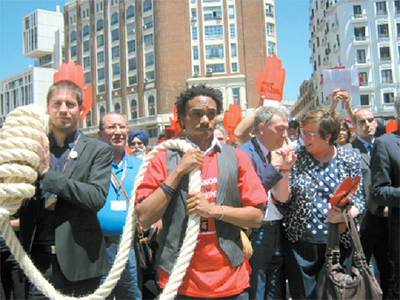
A protest against the execution of Kimberly McCarthy
outside the Huntsville unit of the Texas department
of criminal justice. Photograph: David J. Phillip/AP
27 June, 2013: When Texas crossed the gruesome milestone on Wednesday night by executing its 500th prisoner the news carried a particular punch for Anthony Graves. He could so easily have been one of them.

Two years ago he was exonerated and set free after spending 18 years in Texas prisons, most of that time on death row. His conviction for multiple murder was overturned after an appeals court learned that his case was riddled with problems including a co-defendant who admitted to lying about his involvement, prosecutors who had extracted false confessions and crucial testimony withheld from the defence.

Graves was lucky to escape the fate of Kimberly McCarthy, put to death by lethal injection on Wednesday, but he still feels as though he was one of the 500. "Over 300 men were executed while I was on death row. I got to know many of them like brothers, guys who had faces rather than just numbers."

Among the 500 put to death by Texas since the state resumed the death penalty in 1982 were at least three people who were in all probability innocent. Carlos DeLuna was executed in 1989 having been mistaken for another Carlos; Ruben Cantu was sent to the death chamber in 1993 largely on eyewitness testimony from a co-defendant and a shooting survivor, both of whom later recanted; and Cameron Todd Willingham was put to death in 2004 for starting a fire that killed his three children based on forensic evidence that later turned out to be seriously unreliable.

"What does that say to you about a society?" Graves said. "It says to me that we have not evolved, that there's no justice, that we are still executing people as though our system has no flaws."

Despite the doubts that have been raised in these and other cases, Texas continues to show a degree of enthusiasm for the death penalty that strikingly exceeds that of any other state. Last year the state ended the lives of 15 prisoners – more than twice the number of the next most execution-happy states, Arizona, Mississippi and Oklahoma, which killed six each. The landmark of 500 executions in the modern era vastly overshadows the next state on the death penalty table, Virginia, which has put to death 110.

Such eagerness to judicially kill is reflected in the opinion polls which continue to show overwhelming support in Texas for capital punishment. A University of Texas/Texas Tribune poll last year showed that 73% support it and only 21% oppose.

"We are not in favour of using taxpayers money to support keeping people in jail when they say they would kill again and the jury wants to give them the death penalty," said Ray Hunt, president of the Houston police officers union. Hunt wants to speed up the legal process so that prisoners are executed more quickly, and he wants to extend the death penalty to a wider set of crimes.

"I would give juries the option to impose death sentences for crimes that are heinous such as cutting off your wife's arms with a machete as one Houston man did," he said.

But the stubborn opinion polls and the enduringly high frequency of executions obscure an important truth: even in Texas, the undisputed heartland of the death penalty in America, change is coming. As Kristin Houlé, director of the Texas Coalition to Abolish the Death Penalty, points out, the cases that are now reaching the death chamber have been 10 or 20 years in the waiting and in the interim period attitudes have shifted.

"The executions that are carried out now are a legacy of a Texas as it existed years ago - many of the prisoners scheduled to die would not be put on death row were they to commit their offences today," she said.

The statistics for the number of new death row inmates tell their own story. In 1999 the state reached a peak, adding 48 new inmates. By last year that number had declined to nine, and so far this year juries have handed down just four new death sentences.

There are many reasons for the withering of the death row population in Texas. In 2005 the state legislature introduced a new punishment that allows juries to sentence murderers to spend the rest of their natural lives in prison with no chance of parole – an alternative to the death penalty that is proving very popular.

Juries are also more reluctant to hand out the ultimate punishment – over the past five years they have rejected the death penalty in more than 20 capital cases.

Prosecutors too are becoming increasingly hesitant to press for the ultimate punishment. Part of the reason for their caution is the exorbitant cost of state killings: studies suggest that the average price for the taxpayer of a death penalty case in Texas is $2.3m, compared with $750,000 for keeping a convict in jail until they die by natural causes.

"In smaller counties in Texas, a death penalty case can literally break the budget – it can absolutely break the bank," said Sam Millsap, who was district attorney of Bexar County around San Antonio in the 1980s.

Millsap was chief prosecutor in five capital murder cases during his time as DA. He was by his own description imbued at that time with a "naive confidence in the system's ability to get things right".

But the system did not always get things right. One of those five cases was that of Ruben Cantu, and when many years later evidence emerged posthumously that cast serious doubt on Cantu's conviction, Millsap went through what he calls an awakening.

"My attitude to the death penalty went through a sea-change. I realised that the system I always had so much confidence in was making far too many mistakes."

Now firmly opposed to capital punishment, Millsap has no illusions that his sceptical views are shared by the current crop of Texan DAs who outwardly retain an unbending faith in the death penalty. "They say all the right things in public because they have to. If you don't support the death penalty in Texas you don't get elected."

But he believes that prosecutors are applying much more rigorous criteria today before they launch a capital case, which is bringing down the numbers of new sentences sharply.

A paradox arises from the winds of change blowing across the Lone Star state. As the number of capital convictions falls, the application of the death penalty is becoming even more arbitrary.

Racial disparities are becoming more pronounced. As the Texas Coalition to Abolish the Death Penalty has shown, seven out of the nine new incumbents of death row last year are black and one is Hispanic; only one is white. Over the past five years, almost 75% of all death sentences in Texas have been handed down to African Americans or Latinos.

Geographically, arbitrariness is also on the rise. Since 2008, more than half of all new death sentences have been issued by just five out of the state's 254 counties; Dallas County alone accounts for almost one in five of them.

That is the final paradox of Texas's dark statistic of 500 executions. The count begins in 1976 when the US supreme court allowed executions to start again after it had put a stop to the practice four years earlier.

In that original 1972 ruling, Furman versus Georgia, the supreme court found that the death penalty in America was so arbitrary in its application that it amounted to cruel and unusual punishment in violation of the US constitution. Those who were sent to the death chamber were, the court ruled, "a capriciously selected random handful upon whom the sentence of death has been imposed".

Forty years and 500 executions later, the experience of Texas suggests that the assessment is disturbingly contemporary and chillingly accurate.

Courtesy: The Guardian
Texas executes 500th inmate since death penalty reinstated
Kimberly McCarthy
WASHINGTON : The US state of Texas on Wednesday executed its 500th convict since the death penalty was reinstated in 1976, a record in a country where capital punishment is in decline elsewhere.

Kimberly McCarthy, 52, was declared dead by lethal injection at 6:37 pm  (23:37) GMT in the “Walls Unit,” a red brick prison in the small town of  Huntsville, prison officials said.

After 14 years on death row, time stopped for the former drug addict who  was condemned to death for the savage murder of 71-year-old retired college  professor Dorothy Booth in 1997.

“As the lethal drugs began to take effect her last words were ’God is  good,’” the Texas Department of Criminal Justice said in a press release.

McCarthy, who is black, received two last-minute reprieves in January and  April due to allegations of racial discrimination during the selection of what  became her all-white jury.

But after a Texas appeals court refused to reopen the case, she ran out of  both options and time.

Some of the protesters gathered at
the expected execution of Kimberly
McCarthy in Huntsville.
(Jennifer Emily)
“If there was something to appeal, I would,” her attorney Maurie Levin told  AFP shortly before the execution.

“For procedural reasons, the claims were never reviewed on the merits.”  

Some 1,336 people have been executed across the United States since the  Supreme Court lifted a moratorium on the application of the death penalty in  1976. More than a third of the executions were carried out in Texas.

“It’s very sad, horrific — like in the middle-ages,” said Gloria Rubac of  the Texas Death Penalty Abolition Movement.

“At some point, Texas has to come to the 21st century, the world is 
watching us.”    Rubac was among around 30 death penalty opponents gathered outside the  prison for a vigil as McCarthy’s execution time approached.

They held signs declaring “death penalty is racist,” “end executions in  Texas” and “execute justice not people” as they stood behind yellow tape in a  special zone set up across the street by prison officials.    

Dorothy Booth
“This 500th execution has put a spotlight on Texas, but I hope that light  is going to bring some fresh air here, put pressure to make a change,” Sheryl  Smith, a pastor with the United Methodist Church who attended the vigil, told  AFP after McCarthy’s death was announced.

McCarthy is just the 13th woman to be executed in the United States since  the death penalty was reinstated. Texas has executed three other women and  eight women are current on death row in the Lone Star state.

“It’s a tragedy,” activist Dennis Longmire, a university professor who  lives in Huntsville, said in a telephone interview from the vigil.

“But the 500th execution should be receiving as much attention as the first  one and the 501st one. And tonight’s execution is no less tragic than the next  one or the one we had two weeks ago.”  

Opinion polls consistently show that between 60 and 65 percent of Americans  back capital punishment, indicating that support goes beyond the roughly 50-50  left-right divide in US electoral politics.

However, juries and state officials have become increasingly less willing  to impose the death penalty.

There are currently 3,125 convicts on death row in the United States and  McCarthy was the 17th prisoner put to death in the first six months of 2013,  according to the Death Penalty Information Center, an academic watchdog.

But numbers are dropping: 43 people were executed in 2012 down from a peak  of 71 in 2002.

American juries are also imposing capital punishment in fewer cases, with  only 78 death sentences last year, down by around three-quarters since the  1990s — although violent crime is also down.

While 32 of the 50 US states still have the death penalty on the books many  have imposed a de facto moratorium, with few or none of the executions carried  out and convicts languishing on death row.--AFP

Courtesy: New Straits Times

Wednesday, 26 June 2013

Death is Death: The More Capital Punishment Evolves, the More it Stays the Same
James Eagen Holmes, who faces the death penalty for
his alleged role in the murder of 12 people in
Colorado, may not have faced the same penalty
in ancient Babylon. Photo Credit: Flickr

Vengeance and retribution are both human responses to tragedy, especially violence on a large scale. We’re not interested in justice when unspeakable acts take place. We want blood – now. Because our society is one of laws, angry mobs don’t usually hand down guilty verdicts and exact punishment. We have to wait for the guilty to go through the motions – arrest, “fair” trial, and sentencing – to get what we paid for: that sweet execution. Decades may pass from the time a judge hands down a death sentence to the day it’s carried out. The somber, private occasion that is our modern version of capital punishment brooks no cheers, no joyful singing that the guilty is soon to die. It is not the vehicle of satisfaction the public envisions it to be. There’s no catharsis for the victims, and no deterrence for those who might commit similar crimes in the future. In fact, employing it as a mechanism of the justice system has no place in our modern society – not even for the worst of the worst.

Murder Wasn’t Always a Capital Offense
The Code of Hammurabi contains the first recorded death penalty laws, according to ProCon.org, a nonprofit research charity. Of its 282 separate laws, citizens of ancient Babylon could face death for a number of offenses, including lying in open court, receiving stolen property, or bringing false accusations. However, murder was not a capital offense. Buying a stolen goat results in horrible death, but killing the goat’s owner isn’t such a big deal. What’s this say about those early civilizations? Life was relatively cheap. Possessions, including the buying and selling of slaves, mattered more than the careful application of laws and justice. Monarchical rule also streamlined the carrying out of sentences. If the king (who his subjects also consider a god) believes you to be guilty, there’s little room for an appeal.

As governments increased in size, and decision makers became more varied, the offenses that could land citizens under a headsman’s sword became equally divergent. Methods of execution became just as inventive, and gruesome, designed in large part to exact maximum pain before death finally came.

Death, in and of itself, wasn’t the main deterrence so much as the manner of killing. Governments, lawmakers, and monarchs used these terrible methods of execution as public warnings to the populace.
  • The Brazen Bull – designed in ancient Greece, this method of capital punishment took the form of a hollowed-out bull statue, which executioners placed the condemned inside. A fire placed beneath the statue roasted the condemned alive.
  • Drawing and Quartering – popular in England up until the 1800’s, those executed by drawing and quartering were first hanged until nearly dead, then disemboweled alive. Severed parts of the person’s anatomy shown in the varying parts of the kingdom.
  • Slow Cutting – seemingly fit for a noir thriller, this Chinese method of capital punishment involved the methodical severing of the person’s joints and limbs with the killing stroke (usually a stab to the heart) coming last.
  • Stoning – one of the oldest methods of execution, stoning is a biblical punishment for a variety of offenses, including adultery and blasphemy. Buried up to their waist a gathered crowd throws rocks – not large enough to cause death in a couple throws, but larger than pebbles – at the person until they’re dead.
Killed for Counterfeit Stamps: England and Colonial America

Currently, there are 41 capital offenses in the United States for which death may be the ultimate punishment. The majority involve the murder of another person, though others (treason) involve the betrayal of state secrets to foreign nations. During the 1700s in England, there were more than 200 separate offenses for which death was the only punishment, including cutting down a tree, stealing more than 40 shillings from a house, and counterfeiting tax stamps, according to PBS Frontline. During the reign of Henry VIII, says PBS, the estimated number of people put to death in England ranges upwards of 72,000.

Methods execution varied by class. For royalty and the wealthy, death was a (mostly) painless beheading. However, for those without prominent station, the manner death often took more painful forms from boiling alive to burning at the stake.

Colonial America wasn’t much different when it came to capital punishment. Colonists executed their first criminal, George Kendall of Virginia, for plotting to betray the Crown to the Spanish. By 1612, Virginia’s governor instituted laws so restrictive that residents could suffer the death penalty for seemingly minor offenses, including stealing grapes and killing chickens.
Death is the Best Kind of Psychological Warfare

Fear of death isn’t as big a motivator as being pulled back from the brink of certain execution. During the French and Indian War, then militia Commander-in-Chief George Washington used the threat of summary execution of deserters to keep his remaining troops loyal as he fought battles along the western frontier. On one occasion, he ordered death by hanging for a massive group of deserters, but recanted, and hanged only two, according to the Virginia Foundation for the Humanities.

Why sentence a large group of men to death and execute only two? To show mercy, and at the same time, show others a willingness to punish the guilty. The psychological impact of capital punishment, in both its application and reprieve from it, can instill compliance, loyalty, and even improve morale.

Modern Saudi Arabia also employs psychological effects when it comes to capital punishment, but with an old twist. In a move that mirrors ancient Babylonian law, Saudi officials are reportedly considering a sentence of paralysis for a man who was 14-years-old when he stabbed and paralyzed his friend, according to CNN. Government agents will reportedly carry out the “eye for an eye” style sentence unless the accused can pay $266,000 in compensation to the victim. Of course, that’s going to be hard to come up with considering the attacker has been in prison for the last 10 years.
Public Executions like Carnivals?

Public executions were both a means for the populace to see the guilty punished and to witness the fate that awaited them should they commit similar crimes. The last public execution in the United States took place in Owensboro, Kentucky in 1936. Authorities hanged Rainey Bethea in front of more than 20,000 witnesses for the rape and murder of a 70-year-old woman, according to National Public Radio. Journalists and photographers attending the event, many from as far away as New York, lambasted what they considered to be a “carnival” rather than a somber, dignified occasion. Rainey ascended the scaffold near dawn and died by hanging a short-time later. The public spectacle of the execution is reportedly what led to the banning of public executions in the United States.

States chose to ban these events in the large part because they violate Constitutional protections against cruel and unusual punishment. The Eighth Amendment protects U.S. citizens from punishments considered to bring undue suffering, pain, or humiliation. The need to remove the pain from capital punishment, while still using it as a component of the justice system, is what led many nations to develop more efficient means of executing those convicted of capital offenses.

The gas chamber, electric chair, and lethal injections are all methods developed by modern countries, including the United States, to end life without pain in a humane manner.

However, authorities still screw them up, and when they do, there’s no shortage of collateral damage.

Botched Executions are Justice Served?

Willie Francis survived the electric chair, but that didn’t stop authorities from strapping him a second time and throwing the switch. The U.S. Supreme Court ruled 5-4 that second attempts at execution do not violate the Constitutional rights of the condemned, citing that the electric chair’s malfunction in Francis’ case was “completely accidental.”

Some may argue those convicted of capital offenses deserve whatever punishment they get. The families of victims might suggest that any pain and suffering the guilty experience is “icing on the cake” for the tragedies they’ve forced them to endure. Baying for blood isn’t the same as carrying out a death sentence, and those who witness particularly horrible executions carry the haunting memories for the rest of their lives.
  • Romell Brown leaves an Ohio execution chamber alive after 18 failed attempts to administer a lethal injection.
  • Florida Supreme Court Justice Leander Shaw reacts in horror at photos of Allen Lee Davis who died by electric chair. Shaw reportedly commented that Davis appeared as if he had been “tortured to death.”
  • John Evans caught fire in 1983 when authorities turned on the juice to his electric chair. Evans lived for 14 minutes, and two additional jolts while still burning, until doctors finally pronounced him dead.
  • Authorities cleared the room of witnesses during the gas chamber execution of Jimmy Lee Gray due to his continued desperate gasps for air and loud moans. He reportedly bashed his head continuously on a pole in the chamber as cyanide burned its way through his body. His executioner was allegedly drunk.
We Haven’t Learned: Death and the Dance of Justice

“For James Eagan Holmes, justice is death,” said Arapahoe County district attorney George Brauchler, according to ABC News. Holmes is alleged to have killed 12 people and wounded 70 during a midnight showing of The Dark Knight Rises in Aurora, Colorado. Brauchler, and his prosecutorial team, turned down a proposed plea agreement from Holmes, which would have required him to spend the rest of his life in prison without the possibility of parole. They’re seeking the death penalty, and many victims and the families of survivors applaud that decision. How many times did Brauchler practice that headline worthy snippet in the mirror? Did he imagine it broadcast across the globe by info-hungry media outlets?

Executing Holmes won’t bring back the dead, or provide those left behind with greater comfort. After his legal defense exhaust all of his appeals it may be decades until he sees an execution chamber – if a jury or judge sentences him to death at all. Victims, seeking to move on with their lives and heal, may only have their emotional wounds from that horrible night reopened, all the recovery washed away in a small black box of a room to watch a man die. Suppose a better punishment might be to sit in a maximum security cell for the rest of his days, and know that life goes on without him. If the state sentences this man, who reportedly has a history of significant mental illness, to death, will the execution go as planned? Will witnesses see a man spend his last moments writhing in pain or quietly slipping off to sleep? Suppose neither act gives the emotional release we might all crave as a killer’s survivors.

What does it say about us if we like what we see?
California voters to decide whether or not to outlaw the death penalty
~~Dan Whitcomb, Reuters
LOS ANGELES — California voters will decide in November whether to
Illinois, New Mexico and New Jersey have all chosen
to abolish the death penalty in recent years, and
New York's death penalty law was declared
unconstitutional in 2004.
repeal the death penalty in a state that is home to nearly a quarter of the nation’s death row inmates, after activists collected the more than 500,000 signatures needed to put the measure on the ballot.

The ballot initiative focuses on the high cost of the death penalty in a state that has executed 13 people since capital punishment was reinstated in the nation in 1976. Another 723 inmates sit on death row pending lengthy and expensive appeals.

The move, which comes as a number of states reconsider capital punishment, would abolish execution as the maximum sentence in murder convictions and replace it with life imprisonment.

If the measure passes, it was expected to save the state in the “high tens of millions of dollars annually,” according to an estimate of the fiscal impact of the bill that is included in the text of the measure.

“We’ve spent billions of dollars killing 13 people. There is a much better system,” said Steve Smith, a campaign consultant for SAFE, which got the initiative on the ballot. By contrast, Texas has executed 481 people during the same time period.

The ballot measure was approved as a growing number of states question the use of the death penalty, and comes less than two weeks after Connecticut lawmakers voted to repeal the death penalty there.

California could join 17 other states and the District of Columbia without capital punishment, assuming the Connecticut law goes into effect.

“It’s unusual and could be historic. I don’t think any state has removed the death penalty through referendum since the 1960s. That was Oregon. They (later) reinstated it,” said Richard Dieter, executive director of the Death Penalty Information Center.

“In most states, it’s a legislative process,” he added.

Illinois, New Mexico and New Jersey have all chosen to abolish the death penalty in recent years, and New York’s death penalty law was declared unconstitutional in 2004.

Other state legislatures are considering bills to end the death penalty, and Oregon’s governor has said he would halt all executions on his watch.

‘SPITTING IN THE FACE’ OF VICTIMS?

But opponents of the measure, which would commute the sentences of the state’s existing death row inmates to life in prison, amounted to an assault on victims of what they described as the most vicious crimes in California.

“The individual who qualifies for the death penalty under special circumstances has done a lot more than just kill somebody,” said Assemblyman Jim Nielsen, a Republican from northern California who is the former chairman of the California Board of Prison Terms.

He said that abolishing the death penalty on the issue of cost would amount to “spitting in the face of the grieving victims of these vicious heinous atrocious murderers.”

A Gallup poll taken last year found that a majority of Americans — 61 percent — approved of using the death penalty for those convicted of murder, although support was down from a peak of 80 percent in the mid-1990s.

Similar support was evident in California, where a poll by the state’s Field Research Corporation last year found 68 percent supported capital punishment for serious crimes.

Scott Thorpe, CEO of the California District Attorneys Association, has said reforms to the appellate process could reduce costs associated with executions. He could not be reached for comment on Monday.

In addition to abolishing the death penalty, the California measure would also create a $100 million fund to be distributed to law enforcement agencies to help solve homicides and rapes.

It would also require convicted murderers to work in prison, and would apply their wages to any victim restitution fines or orders against them.

State Senator Loni Hancock, a Berkeley Democrat who backed a bill in 2011 that would have placed a similar measure on the ballot, said the initiative would give voters the chance to eliminate a punishment that is rarely carried out and costs $184 million a year more than life imprisonment of the same felons.

Tax money is being spent on death penalty appeals while community colleges and libraries face cuts, Hancock said. At the time it was approved, she said, “people really didn’t understand, and still may not, the cost implications of the death penalty.”

A spokesman for California Governor Jerry Brown could not immediately be reached for comment.

Courtesy: National Post

Death Row Prisoner To Be Executed By Firing Squad In Benin
June 25, 2013: A death row prisoner in Nigeria is due to be executed by firing squad later this week after prison authorities dragged him to the gallows where they hanged four other men on Monday night, Amnesty International has said.
They were the first known executions in the country since 2006.

Benin Prison authorities in Edo state had planned to hang the man along with the four others, but halted his execution after they realized his death sentence, imposed by a military tribunal, required that a firing squad carry it out.

Amnesty International said it understands that neither the prisoners nor their families were told of the executions in advance. Secret executions, where prisoners, families and lawyers are not informed beforehand, violate international standards on the use of the death penalty.

“Cruel and inhumane do not even begin to describe the nightmare situation facing this man – and it points to the spectacularly brutal nature of Nigeria’s sudden return to state-sponsored killing,” said Lucy Freeman, deputy Africa director at Amnesty International.

“The resumption of executions in Nigeria is deplorable and extremely worrying. Edo state authorities have already executed four men this week and still plan to execute a fifth – the Nigerian authorities must immediately halt all executions and return to the moratorium on the death penalty that was previously in place.”

The four men hanged at Benin Prison last night still had appeals pending in their cases. Their executions came only hours after a federal High Court had dismissed a lawsuit against three of the execution warrants. The Edo state Attorney General and the prison authorities ignored an appeal and application for stay of execution filed immediately after the judgement. By executing the prisoners, Nigeria has demonstrated a gross disregard for the rule of law and respect for the judicial process.

The fifth man, sentenced by military tribunal, was never able to appeal his original sentence because military tribunals at the time denied defendants the right to appeal – itself a violation of fair trial standards and international law.

Under Nigerian and international law, executions may not be carried out while any appeals are still pending.

“Authorities at Benin Prison simply disregarded the due process requirements under law and in a cold-blooded move they denied the inmates an opportunity to exercise their rights,” said Ms Freeman.

The fifth man who is to face a firing squad has been on death row for 17 years, and was sentenced to death by a military tribunal during the military rule in Nigeria before the return to democracy in 1999. Amnesty International has raised serious doubts about the fairness of trials during that period.

Of the more than 1,000 people currently on death row in the country, scores of others were also sentenced by military tribunals before 1999.
“That Nigeria has resumed executions for sentences passed by military tribunals only amplifies the disregard for human rights,” said Ms Freeman.
“At a time when West Africa and the world are moving away from the death penalty, it is very worrying that Nigeria’s President Goodluck Jonathan defies the clear international trend and has instead encouraged a step backwards for human rights.”

Earlier this month, President Jonathan urged state Governors to sign death warrants for death row prisoners – which in effect allows federal prison authorities to proceed with executions of inmates who are held at state prisons.

The Edo state Governor, Adams Oshiomhole had signed execution warrants last October for two of the four men executed on Monday.

Amnesty International opposes the death penalty in all cases without exception, regardless of the nature or circumstances of the crime, or the individual’s guilt or innocence because it is a violation of the right to life and the ultimate cruel, inhuman and degrading punishment.
A history of capital punishment in Texas
In this photo taken June 12, 2013, death penalty
opponents gather outside the Huntsville Unit
before the execution of confessed killer
Elroy Chester in Huntsville, Texas.
(AP Photo/Pat Sullivan)
~~By The Associated Press
Jun 26, 2013:Milestones in capital punishment in Texas:

1819 - George Brown is first person executed in Texas, by hanging.

1863 - Chipita Rodriguez is first woman executed in Texas, by hanging.

1923 - Lee Nathan becomes the last of 394 people executed by hanging.

1924 - Charles Reynolds becomes first inmate to die in the electric chair in Huntsville as state takes over executions.

1963 - Joseph Johnson is the last of 361 Texas prisoners to die in the electric chair.

1972 - U.S. Supreme Court finds death penalty "cruel and unusual;" death sentences of 52 people in Texas are commuted to life in prison.

1976 - U.S. Supreme Court holds Georgia death penalty statute constitutional, setting stage for resumption of executions.

1977 - Texas adopts lethal injection method.

1982 - Texas inmate Charlie Brooks becomes first in U.S. to receive lethal injection.

1998 - Karla Tucker becomes first woman executed in Texas since Civil War.

2000 - Texas executes a record 40 prisoners in one year.

2013 - Texas schedules execution of Kimberly McCarthy, number 500 by lethal injection.
__

Sources: Texas Department of Criminal Justice, "Espy File" database compiled by historians M. Watt Espy and John Ortiz Smykla.
Copyright 2013 The Associated Press. All rights reserved. This material may not be published, broadcast, rewritten or redistributed.

Courtesy: CTV News
Texas set to execute 500th death-row inmate
~~By Sophia Rosenbaum, NBC News
Texas is poised to execute its 500th inmate since reinstating the death penalty in 1982, passing a grim milestone in the state that has executed more prisoners than any other state in the country.

Kimberly McCarthy, 52, is scheduled to be put to death by lethal injection at 6:10 p.m. Wednesday, making her one of a small number of female death row inmates who have faced capital punishment.

A former cocaine addict, McCarthy was convicted of killing her 71-year-old neighbor during a 1997 robbery. She was found guilty of using a butcher knife and candelabra to beat and stab retired college professor Dorothy Booth. Using the same knife, she severed Booth’s finger to steal her wedding ring.
McCarthy was granted a retrial by an appeals court in 2002 on the ground that police had obtained her confession illegally, but was sentenced to death row again.

Members of Booth’s family say they don’t care about Texas' macabre tally, only about justice for their loved one.

“The only significance for us is that Kimberly McCarthy, because of her crack cocaine addiction or her sociopathic personality, deprived us of Dorothy Booth,” said Randy Browning, the victim’s godson, told The Dallas Morning News. “Whether it’s the 500th or the 5,000th, it doesn’t matter.”

Browning has said he plans to attend the execution Wednesday evening.

A death row inmate is executed every three weeks in Texas, a rate that far exceeds that of any other state in the country. Texas is the leader in executions in the U.S. by about four hundred, with Virginia at a distant second. Since the Supreme Court ruled on death penalty laws in 1977, Texas has accounted for 40 percent of the more than 1,300 executions carried out nationwide.

Despite a cultural shift away from the death penalty in many parts of the country, 32 states still allow the death penalty.


The rate of executions has declined in recent years in Texas, as well. More than three dozen people were executed in the state in 2000. This year, McCarthy will be the eight person subjected to capital punishment.

But many Texans support the death penalty, according to a 2012 poll done by the Texas Tribune and the University of Texas. Only 21 percent said they were opposed to capital punishment.

"I think our process works just fine," Perry said in 2012 during his unsuccessful presidential bid. "You may not agree with them, but we believe in our form of justice.”

McCarthy will be the first woman put to death in the U.S. in more than three years and the 13th woman since the Supreme Court's 1976 ruling that allowed executions to resume. The last woman executed in the United States was Teresa Wilson Lewis in Virginia on Sept. 23, 2010.

In the past year, McCarthy’s execution has been pushed back twice, most recently in early April. Her attorney, Maurie Levin, continues to fight for McCarthy, but her latest appeal to the Texas Court of Criminal Appeals was rejected on Tuesday.

Levin said that black jurors were improperly blocked from McCarthy's trial, a claim the convicted woman made in her appeals.

“The shameful errors that plague Ms. McCarthy’s case – race bias, ineffective counsel, and courts unwilling to exercise meaningful oversight of the system - reflect problems that are central to the administration of the death penalty as a whole,” Levin said.

McCarthy’s trial was decided by an all-white jury despite Levin’s claim that four non-white jurors qualified to sit trial. McCarthy is black, and Levin said the Dallas County jury selection process has a “troubling and long-standing history of racial discrimination in jury selection.”

The only way McCarthy could avoid the death penalty is if the court said it wanted more time to review the appeal, said John Hurt, prison agency spokesman for the Texas Department of Criminal Justice Huntsville Unit.

But Levin told NBC News on Wednesday morning there is “no chance” of that happening because the court already struck down her appeal.

“For this to be the emblem of Texas’ 500th execution is something all Texans should be ashamed of,” she said.

There are currently 283 men and women on death row in Texas.

The Associated Press contributed to this report.

Courtesy: NBC News

Tuesday, 25 June 2013

Mom Locks Child in Room Where She Shoots, Kills Self
Police say 5-year-old found loaded .38-caliber revolver
This photo provided by the New
Orleans Police Department shows
Laderika Smith, 28.
 
(Newser) – A woman who locked her 5-year-old daughter up in a room with a loaded gun has been charged with second-degree murder in the child's death, police in New Orleans say. Initial investigations show that the girl found a loaded .38-caliber revolver in the bedroom and accidentally shot herself in the head, a police spokesman tells the Times-Picayune.

Laderika Smith, 28, who admitted that she left the child locked alone in a room while she went to the store, was initially charged with child cruelty but the charge was upgraded to murder after her daughter was taken off life support yesterday afternoon. The Advocate spoke with a relative who lives in the home and claimed possession of the gun—but said he was keeping it for someone else, and, by raising his arm, suggested to the Advocate reporter that he kept the gun high up in the room. He didn't give any more specifics about its location.

Courtesy: Newser

Sunday, 23 June 2013

Conservative MPs launch attempt to bring back death penalty, privatise the BBC and ban burka
The traditional Conservatives would like a bank
holiday named after Margaret Thatcher
Photo: Daily Telegraph
Conservative MPs have drawn up an “Alternative Queen’s Speech” with radical policies such as bringing back the death penalty, privatising the BBC and banning the burka in public spaces.
20 Jun, 2013:  The 42 bills also include legislation to scrap wind farm subsidies, end the ringfence for foreign aid spending and rename the late August Bank Holiday “Margaret Thatcher Day”.

Britain’s relationship with Europe features prominently in the action plan, with draft laws setting out how the UK would leave the European Union and a Bill to prevent Bulgarians and Romanians winning new rights to work, live and claim benefits here from next year.

All of the proposals were laid before the House of Commons last night after the Tory backbenchers hijacked an obscure Parliamentary procedure by camping out in Westminster for four successive nights.

Many of the less controversial policies – including legislating for a transferable tax allowance for married couples and making the Coalition’s introduction of same-sex marriage subject to referendum – are known to be very popular amongst Conservative MPs.

Those MPs behind the alternative legislative programme say it is a “genuine attempt” to show what policies a future Conservative government could deliver.
 
Peter Bone, the MP for Wellingborough and one of the architects of the document, said: “This is serious attempt to deliver policies that the British public really want. There are ideas here that could form the basis of a future Conservative manifesto.”

When asked what he thought David Cameron would make of the policies, Mr Bone: “I think the Prime Minister will be pretty relaxed about this.”

One of the proposed Bill’s would privatise the BBC, with all license-fee payers awarded shares in the corporation. A separate bill would de-criminalise non-payment of the licence fee.


The programme also includes plans to abolish the Office of the Deputy Prime Minister – a post currently occupied by Nick Clegg, the Liberal Democrat leader – as well as legislation to abolish the Department of Energy and Climate Change and reintroduce national service.

All of the 42 proposed Bills may now be subject to debate in Parliament over the coming months after members of the group staged a four-day sit-in at a committee room the House of Commons' Public Bill Office.

In order to be first in the queue to put down their private members’ bills yesterday (Thursday) morning, members of the Tory grouping first appeared outside the office at 10pm on Sunday evening.

In order to keep their place in the queue the four members of the group adopted a rota, with the Kettering MP Philip Hollobone agreeing to spend four nights crashed out on a camp bed with little but a flask of coffee for company.

Mr Hollobone said: “It was four nights in a rather hot, square stuffy room right under Big Ben – so not conducive to a good night’s sleep. But it ensured that we were first in the queue when the slots for Private Members’ Bills were given out.

“This is a way for us as MPs to ensure that these popular policies wanted by so many of our constituents get Parliamentary airtime over the months ahead.”

David Nuttall, the MP for Bury North, and Christopher Chope, who represents Christchuch, also took turns to keep the group’s pole position.

The vigil ensured that all of the 42 policies proposed in the Alternative Queen’s Speech have made it on to the House of Commons Parliamentary Table and are set to be heard as Private Members’ Bills between now and May next year.

Details of the alternative Queen’s Speech came as another major Conservative rebellion loomed with a former minister amending the Finance Bill to give MPs a vote on whether to give stay at home mums a marriage tax break

Education minister Tim Loughton tabled an amendment to Finance Bill later on Wednesday to bring into law a transferrable tax allowance for married couples.

The amendment, which will be voted on by MPs, could force the Government to ask its MPs to vote against a Tory manifesto Coalition agreement commitment.

Scores of Conservative MPs expected to support the amendment, which would initially limit the allowance to couples with a child aged under the age of five, when it is voted on early next month, although it is likely to fail because of opposition from Labour and the Liberal Democrats.

The Daily Telegraph understands the whips sent veteran backbencher Sir Edward Leigh to beg Loughton not to table the amendment. But he has ignored their pleas.

Mr Loughton said: "The Prime Minister has reiterated his huge enthusiasm for marriage. It is long overdue for him to put our money where his mouth is and honour the longstanding Conservative pledge to restore a transferable married couple’s tax allowance and send out a clear message that we value marriage and family socially and financially.

"More than three years on from our manifesto commitment to bring in a transferable tax allowance, ratified in the Coalition Agreement, it appears no nearer and the patience of many hardworking home based parents is being severely stretched.

"Time is running out to make good on our very clear commitment and the Report Stage of the Finance Bill presents one of the last opportunities to put this important measure on the statute book before the next election.

"My amendment gives the Chancellor maximum flexibility to do this and I hope he will seize this late opportunity.

"Hardworking parents who are trying to do the best by their children and saving the State a fortune in the process are relying on us to produce the goods.

The amendment would come into effect from 2015 and be available to all married couples or those in civil partnerships with at least one child living at home below the age of five, allowing the Chancellor to alter the age qualifications at subsequent Budgets.

The amount of the allowance which can be transferred between spouses would be decided by the Chancellor and subject to a parliamentary Order.

Mr Loughton added: "The Government has rightly made a priority of supporting hardworking families in these difficult economic times.

"But there are also many hardworking married families or in civil partnerships where one of the parents is working hard at bringing up children in the home.

"Yet almost uniquely amongst Western economies they receive no recognition in the tax system and many have been big losers from changes to child benefits and other allowances."

Courtesy: The Telegraph
The Death Penalty's Slow But Seemingly Sure Decline
~~by Alan Greenblatt
Illinois Gov. Pat Quinn speaks with reporters
at the Capitol in 2011 after signing
legislation abolishing the death
penalty in the state.
June 21, 2013: The death penalty has become a bit like the Cheshire cat in Alice in Wonderland. It may never fade away entirely, but capital punishment is certainly less visible or actively pursued than it used to be.

In May, Maryland became the sixth state in as many years to abolish the death penalty. Across the nation as a whole, fewer criminals are being put to death. Last year, 43 were executed, down significantly from the peak of 98 back in 1999.

With violent crime well down from its scary highs in the 1990s, pressure on politicians to support the death penalty has declined as well. And in recent years, courts have made carrying out the death penalty less likely for various legal and logistical reasons.

"Even in places where the death penalty is regularly used, it's slowing down and in some cases it's stopped altogether, so the public is not engaged with it," says Deborah Denno, a law professor at Fordham University. "For the most part, I see abolitionists being more successful than not."

But supporters of the death penalty say it's still a necessary tool for punishing the worst of the worst offenders. They note that, as measured by polls, a solid majority of Americans still support the death penalty — 63 percent, according to a Gallup in January.

"Basically, nobody likes the status quo," says Kent Scheidegger, legal director of the Criminal Justice Legal Foundation, which supports victims' rights. "The question is whether to mend it or end it, and different states have gone in different directions on that."

Political Dynamics


Remember "double-death Democrats"? That gruesome name was surprisingly common 20 years ago, referring to Democratic politicians who supported both the death penalty and abortion.

Its currency was a sign that no politician wanted to be seen as anything other than tough on crime.

But times have changed. The murder rate has been sliced nearly in half over the past 20 years, in keeping with a dramatic drop in violent crime overall. Politicians are now more willing to consider alternatives to the death penalty.

The publicity given to cases in which convicts have later been found innocent thanks to DNA evidence has also created some qualms about potentially putting the wrong person to death.

One test case of the death penalty's continuing political relevance could come in Colorado. Democratic Gov. John Hickenlooper threatened to veto legislation this year that would have abolished the death penalty, but in May he offered convicted killer Nathan Dunlap a "temporary reprieve" from execution, which had been scheduled for August.

"If the state of Colorado is going to undertake the responsibility of executing a human being, the system must operate flawlessly," Hickenlooper said. "Colorado's system for capital punishment is not flawless."

Republicans were fierce in their attacks, with state Sen. Greg Brophy, a potential challenger against Hickenlooper, calling the governor's decision "gutless."

Use Is Rare

Executions are allowed in 32 states, but the most recent ones have been concentrated in Southern and Sun Belt states such as Texas, Mississippi and Arizona, with occasional exceptions in places like Ohio.

The Supreme Court has narrowed the cases for which capital punishment can be applied, limiting it to murderers, and banning it for minors and those who are "mentally retarded."

Plenty of states have the death penalty on the books and prisoners on death row, but have not carried out executions for years.

Dunlap would have been the first person put to death in Colorado since 1997 and only the second since 1967. California, which has the largest death row population — 727, according to the Death Penalty Information Center — hasn't carried out an execution since 2006.

Like a number of other places, California has faced legal hurdles, with justices skeptical about methods of lethal injections. The drugs used in lethal injections are getting harder to find, with manufacturers shying away from the business.

"Litigation on this front remains immensely successful, so it becomes a de facto moratorium," says Denno, the Fordham law professor.

Evolving Standards


With the death penalty being so rare and so difficult and expensive to carry out, abolitionists have been able to make the case in several states recently that it would be better to do away with the practice altogether.

"The abolitionist's strategy, which may succeed though I hope not, is to get more states to abolish the death penalty legislatively because they don't use it anymore," says Robert Blecker, a professor at New York Law School.

If they can win in enough states, they'll ultimately try to convince the Supreme Court that "evolving standards of decency" demand the death penalty be struck down as cruel and unusual punishment, Blecker says.

That may not happen anytime soon. Rather than abolishing the death penalty, some states are trying to address its problems.

In Florida, Republican Gov. Rick Scott this week signed a bill meant to expedite the process.

States have always varied when it comes to this issue. Even though capital punishment may remain forever in force in some states, the trend nationwide is clearly against its wide-scale use.

"This is really, certainly north of the Mason-Dixon Line, part of an endgame for states that have had death rows and little enthusiasm for executions," says Franklin Zimring, a law professor at the University of California, Berkeley.

Courtesy: npr.org
Growing wave against death penalty
Sunday, June 23, 2013: It may indeed be that European countries lead the global abolitionist movement because that part of the world has seen too many wars and too much death and killing in too many lifetimes. But further, deeper reasons were advanced for the cause during the June 15 closing ceremony of the Anti Death Penalty Congress in Madrid, after abolitionists from around the world met for four days to gauge their efforts in the last three years.
 
Held under the auspices of the French, Spanish, Swiss and Norwegian governments, the conference held by the World Coalition Against the Death Penalty calculated the growing pluses of the movement and minuses that still need to be dealt with globally. Among them, the Caribbean, where 13 territories including T&T still retain the death penalty and which will be the focus of the movement’s October 10 World Day Against the Death Penalty observances and a heightening of the abolition thrust in this region.

After 21 debate sessions over June 12 to 15, with input from 1,500 participants from 90 countries, the movement has reported expansion of the abolition thrust to 70 states, with hardliners like Iraq showing promise of softening its stance (slightly). Robert Badinter, former French justice minister and author of France’s abolition law, regarded as the movement’s godfather, challenged the Madrid Congress to complete the job towards universal abolition, though he didn’t expect to see it in his lifetime.

The movement’s challenges lie with the retentionist states of Asia, Africa, the Middle East and the Caribbean. Despite Middle East resistance based on culture, religion, terrorism and weak political systems, the conference concluded with formation of the Middle East General Assembly to focus on that area.

Some of India’s legal practitioners pressing for abolition have appealed for the next congress to be held in India. This bid may be pipped by Africa which was called upon by the European Commission for Human Rights to play a leadership role in the future abolition thrust. Certain African states like Rwanda have become abolitionist to assist in cleaning former histories of blood and gore.
  
Next congress in a retentionist state
The closing session’s announcement that the next congress will be held in a retentionist country, confirms advances the movement has made since its global meetings began in 2001. The WCADP appears more solidly seated now to take members onto retentionist soil. Part of the increased confidence comes from the fact that in the US—a Caribbean neighbour—a retentionist country, the death penalty is on the decline according to Richard Dieter, executive director of the US Information Centre for Capital Punishment.
 
Dieter, among congress panellists, said the death penalty peaked in 1999 in the US with 98, and since 1999 there has been a 56 per cent drop in executions as well as among the number of states halting this. There’s been a 75 per cent reduction in executions, Constance de la Vega Law University professor added.
 
Out of 50 states, only nine did executions in the last year, and some US states are in “moratorium phase,” he added. Dieter said the death penalty is concentrated mainly in southern USA, and there has been no sentences or executions since 2012. US Federal government systems, however, retain the death penalty for all states. Reasons for the decline have been US Supreme Court decisions limiting the sentence for juvenile offenders and restriction of the death penalty to murder, he said.
 
Colorado University professor, Michael Radelet, another panellist, said 49 per cent of Americans support the death penalty. The rest, support life without parole. He said, “We still have a long way to go in the US, but the picture is optimistic.”
 
Radelet said the US may have to look to the next 2016 US presidential election—since the president appoints supreme court judges and that could drive the US death penalty debate.  “...Or president Hillary Clinton or Michelle Obama,” Radelet quipped.
 
The Caribbean, which is the focus of the abolition’s movement’s October 10 conference in T&T, is located between the abolitionist countries of South America and the retentionist USA.

T&T’s Leela Ramdeen was asked by congress participants in Madrid if T&T and regional states were influenced by the US in any way. She said no. Regionally ten countries are abolitionist in law—Grenada and Suriname are considered abolitionist in practice and 13 retentionist states include T&T. The abolitionist movement regards the Caribbean as a paradox since there are few executions among the core of countries strongly opposed to abolition.

While the WCADP has noted positions by T&T, Jamaica and Cuba on the issue, it has also noted the issue of capital punishment has “dramatically declined,” highlighting the apparent disparity between policy and practice. The last execution in the Caribbean was in 2008 in St Kitts—the only one since 2003. Only three states issued death sentences in 2012—Barbados, Guyana and T&T. While Cuba and Dominica have no death row prisoners, six states have only one person and T&T has 33.

The movement also notes Caribbean states’ resistance to United Nations resolutions seeking a death penalty moratorium. Nine states including T&T voted against this. Despite use of the death penalty as a crime deterrent, the movement has noted some governments are increasingly realising they must focus on prevention rather than punishment.
 
Citing anti-crime measures ranging from poverty reduction to education and youth programmes, abolitionists said measures in various Caribbean states are “starting to have some impact.”

Following the announcement of the October 10 conference in T&T, Attorney General Anand Ramlogan said on Tuesday, T&T was well appointed for all meetings. He said, “T&T is the meeting place of the Caribbean, and we’re happy to welcome all international delegations. We’re always interested in the advancement of sensible discussion on the development of human rights.

“It is to the credit of the World Coalition Against the Death Penalty that they and their regional counterparts seek to hold their conference in a country that retains the death penalty as part of its laws. It speaks to the maturity of the agenda and discussions. “We know the issue is a very emotional topic and a high political issue in the region where there’s an unacceptable level of crime, and it will no doubt engender a spirited discussion and give us all an opportunity to present the flip side of the coin.”

Prior to the congress, Ramlogan said ultimately it’s an issue the people will decide upon.  At the congress, US’s Radelet also said it was a matter some US populations would decide on.
 
But as far as the abolition movement seems concerned, the final word—and it remains to be seen if it will be heeded universally—may belong to UN commissioner for Human Rights  Navanethem Pillay, who called on congress participants to remember “....every time we kill in the name of the people, a piece of our own human dignity is shattered...”

The Anti Death Penalty credo

• Studies show the death penalty isn’t a crime deterrent
• Revenge killing for murder isn’t justice
• Halt hanging—not lives
• Deal with crime, not in more death
• No state should have the power to take a citizen’s life
• It breaches the 1948 universal declaration of Human Rights
• Death penalties create more pain
• It is unhuman, cruel, degrading
• Some victims’ families see no sense in seeking death for their relatives killers
• It is inefficient and denies any possibility of rehabilitation
• A life sentence without parole is similar to a death sentence
• Alternatives can include life sentences subject to review.

Courtesy: Guardian Media
India has forgotten how to laugh: Navjot Singh Sidhu
Navjot Singh Siddhu, who has joined comedian Kapil Sharma's maiden production venture "Comedy Nights With Kapil" as a facilitator, says very few people laugh despite the fact that laughter is a stress-buster.
He was also part of " The Great India Laughter Challenge" and says he liked the title of the show because he felt that "laughter was taboo" in the country.

 "India has forgotten to laugh, we are too formal in life. When I saw my family laughing, I realised that I had inhibitions about laughing. Let a show be a stress-buster. We don't go into that zone. We manufacture trouble for ourselves. Amidst all these troubles, laughter is a stress-buster where you sit in front of TV for an hour and unwind and de-stress yourself," he told IANS.

Talking about Kapil's show, going on air June 22 on Colors, Sidhu said: "I am a facilitator on the show. Kapil is the hero and there are side heroes."

He clarified that he is not judging the show.

"I have never ever judged people. Only god can judge people. We all have our faults and limitations. There is just scope for improvement. We just give an overview of how things can be better," he said.

Talking about his future work, he said he is interested in anything that "excites me" and "makes me happy".

"Any undertaking where I enjoy the job. I ensure that I do not accept anything, which becomes a burden. TV is merciless. You are on your own, it all depends on how good you are. It is all on merit," said Sidhu, who also participated in "Bigg Boss 6".

Wednesday, 19 June 2013

Mulayam praises Brahmins for their role in development
GORAKHPUR: Samajwadi Party president Mulayam Singh Yadav visited the city to attend a function at DDU Gorakhpur University. In his address, Yadav highlighted the plans and achievements of the state government.

He praised Brahmins for their role in the development of the country. "Brahmin community has always supported the society and participated in the process of development. The community had always fought to eradicate the evils of the society."

 "The state government is all set to control the problem of unemployment. Farmers would be benefited as the government had already started the programme of free irrigation," he said. Yadav blamed the previous government for the poor condition of minorities, who played 80% role in forming the BSP government. The SP chief also sought support of intellectuals for the betterment of the society, "We require the support of intellectuals as they've always come forward to serve the society." He gave the example of Yogi Baba and Baba Bhawnath, who worked for social reforms throughout their lives. "The state government has granted Rs 30,000 for the education of poor Muslim and other girls. Development is impossible without education," he stressed.

Yadav said that in order to control unemployment, the SP government had allowed recruitment of constables in police and PAC. Talking about farmers, he said, "The farmers of the state are in pathetic condition. The government has given facility of free tubewell and canal irrigation to lessen their woes." PWD has started the programme of renewing construction of roads in the state.

Yadav said that Samajwadi Party is following the principles and policies of Ram Manohar Lohia. Vidha Sabha speaker Mata Prasad Pandey was the president of the programme. DDU Gorakhpur University VC PC Trivedi and other intellectuals discussed the issues of Poorvanchal.

The West offers platitudes but no answers on Syria
~~Nabila Ramdani
Jun 19, 2013: According to the latest United Nations figures, at least 1,700 children under the age of 10 have so far been killed in the Syrian civil war. This statistic is particularly poignant for those of us who have travelled in and around the now-blighted country and met many members of its predominantly youthful population, but it will also trouble millions of others who have never even been to the Middle East.

There is something uniquely upsetting about infant corpses, especially ones of boys and girls who have died in a war where the total number of deaths is fast approaching 100,000.

Such thoughts were on my mind when, last week, US president Barack Obama suggested that a "red line" had been crossed by the use of chemical weapons in a conflict which has now raged for more than two years.

Mr Obama made it clear that Bashar Al Assad, the Syrian dictator, had now overstepped the mark, and that he would suffer consequences for such behaviour.

At the time of writing, it is not entirely clear what those consequences will be, except that Mr Obama intends to prosecute some kind of limited war by proxy against Mr Al Assad.

The American head of state's sometimes muddled rhetoric rules out direct intervention - a strategy perhaps based on aerial bombardment followed by troops on the ground - but instead implies weapons being shipped to the rebels as a means of tipping the progress of the war in their favour.

This is a hugely risky strategy, and one which could easily escalate matters to more frightening levels. But what is particularly significant about Mr Obama's "red line" is just how long it took the Assad regime to cross it.

The use of sarin - a poisonous gas 500 times more toxic than cyanide - is a vile moral act, and also a blatant breach of international law. Just one milligram of the nerve agent can kill a human being, after first reducing him or her to a quivering, suffocating mass of intense pain.

When, a year ago, I was first shown pictures of 46-year-old Syrian Hassan Abdel-Razzaq's dead family, I experienced as much revulsion as perhaps Mr Obama did when he was presented with alleged scientific proof of the use of sarin.

Mr Abdel-Razzaq had returned to his home in Houla in May 2012 to find his wife, Ghaida, and their five children slaughtered. Safa, his four-month-old daughter, had a bullet in her head, having been shot at close range by militiamen loyal to the Assad regime.

The world reacted with predictable outrage to the massacre at Houla, and there was even talk of the event as a "game-changer". UN secretary general Ban Ki-Moon said Syria could soon go from "tipping point to breaking point".

Mr Abdel-Razzaq, meanwhile, told me to get the photographs of his dead children published, saying: "I wanted the world to see what happened to my family. I also took pictures so that there would be evidence of what had happened."

As it turned out, Russia and China continually blocked attempts to introduce UN sanctions against Syria. Intense fighting not only continued in the country, despite the deployment of some 250 UN observers, but got far worse. More massacres followed, to the extent that they are now barely reported by the international mainstream media.

Instead, Syria was considered a dangerous tinderbox which could spark an all-out regional war if the Assad regime was further provoked.

Russia and Iran are still likely to offer assistance to Mr Al Assad, despite what countries like the US, Britain and France might think of him. So what if the latter do manage to get more weapons to the insurgents? Is flooding the region with even more small arms likely to lead to a rebel victory, let alone any kind of lasting peace?

What is far more probable is that opposing groups in the region will continue to stir up disharmony, bitterly fighting for their own goals, regardless of the long-term threat to peace.

Lebanon's Hizbullah is already backing up Mr Al Assad militarily on the ground, for example. Its alliance is based on numerous factors, including Syrian support for its ongoing campaign against Israel.

The truth is that a child killer like Mr Al Assad will not in the least be worried by claims that he has "crossed a red line".

Civil wars are by far the worst kind, and the sort of mass killings which have been going on are as close to genocide as you can get. Four million Syrians - a fifth of the population - have also been forced to leave their homes, often because they have been destroyed.

Yes, the poison gas has reduced the conflict to new depths of barbarity, but is its alleged use that much worse than babies being shot in the head?

What Mr Obama and his allies have really offered in the face of outrageous war crimes is "red line" jargon - the kind that changes nothing. Instead of prosecutors trying to indict Mr Al Assad and his generals on crimes against humanity at the International Criminal Court, as they should have done months ago, the West presents too many meaningless platitudes.

In the meantime, millions are affected by a civil war which the international community still has next to no will to do anything about.

Nabila Ramdani is an award-winning French-Algerian journalist and broadcaster who specialises in Islamic affairs and the Arab world

On Twitter: @NabilaRamdani

Tuesday, 18 June 2013

Putin is right on Syria, Obama is wrong
WASHINGTON, June 18, 2013 ― Russian President Vladimir Putin advises us to keep our hands off Syria, but our own president is moving ahead anyway.

Fools keep rushing in. Apparently, President Obama has learned nothing from our folly in Egypt, where we traded in Hosni Mubarak for the Muslim Brotherhood.

Suppose we do help topple Syrian strongman Bashar al-Assad with small arms and ammunition for the rebels, as Obama proposes to do?

One guess as to who is ready to replace him.

We seem to have a habit in this country to root for the underdog, even if the underdog is Al Capone.

Putin has his own selfish reasons for wanting the West to stay out (he is a supporter of Assad), but given Russia’s own misadventures against looming radical Islam in such places as Tajikistan, Afghanistan and Chechnya, Putin may have our best interests at heart after all. A Russian who cherishes an American Super bowl ring as much as he does can’t be all bad.

In places where people wage the wars of Allah, we frequently get Black Hawk Down when we interfere.

For once, doing nothing was the smart move. Obama played it cool for the longest time, until over-zealous hawks like Sen. John McCain and Charles Krauthammer got to him. Retaliation works on ice during a dull hockey game when fans yell out, “Hit somebody.” But such rashness it is not what we need in a foreign policy.

Do we know exactly who is getting all that military equipment? The Syrian rebels probably call themselves freedom fighters, but that is what terrorist masterminds Osama bin Laden and Yasser Arafat called themselves. Overall and over the years we haven’t been too sharp when sorting out the good guys from the bad guys.

Too often our guns and bullets fall into the wrong hands.

We provided thousands of guns for a “walk” into Mexico in order to trace Mexican drug lords. We ended up losing both the guns and the drug lords. We got similar results when we chose the Palestinian Authority to serve the cause of “peace and security.” Large numbers of those military supplies wound up in the welcoming arms of Hamas and Hezbollah.

As noted, we sided with the rebels in Egypt only to find that these guys were even worse than those guys. Ditto Tunisia and Libya.

After all the blood, sweat and tears for Iraq, swaths of that country keep plunging into chaos. It is not much better in Afghanistan; maybe worse. That is where nearly everybody takes a shot at bringing peace to a land of perpetual chaos. Now it is our turn and this takes us from one quagmire to the next without taking a deep breath.

In Afghanistan, where the Taliban are deemed evil incarnate, al Qaeda are the good guys.

We tend to forget that in some wars, both sides are rotten to the core.

So what awaits us in Syria? Here is Putin in his own words about those Syrian rebels, after the Internet showed a gruesome image: “You will not deny that one does not really need to support the people who not only kill their enemies, but open up their bodies, eat their intestines in front of the public and cameras. Are these the people you want to support?”

Maybe he knows something we don’t know.

Courtesy: The Washington Times